Managing industrial door maintenance across one facility is one thing. Managing it across ten, twenty, or fifty locations is a different challenge. Without a shared plan, service quality varies by region, costs get hard to predict, and facility managers spend more time chasing vendors than running their sites. National account management fixes that problem by replacing a patchy vendor mix with one accountable partner.
The Hidden Cost of Fragmented Service Across Locations
Most multi-site operators do not start with a broken approach. They grow into it. Each new facility brings its own service history, its own local vendors, and its own habits. Over time, those gaps add up. One site may run on a set inspection plan while another relies on reactive repair. One location may have clear equipment records while another cannot name the age of its dock levelers. Because each site developed on its own, the gaps are often invisible until something goes wrong.
The effects show up in real ways. Variable service across sites leads to variable safety outcomes. Unpredictable repair cycles mean unpredictable costs. Thin records limit the ability to plan spending or show OSHA compliance across the full portfolio. Each issue is workable on its own. Together, they create a serious risk for any company running facilities at scale. That is why a national account structure is not a luxury item for large operators. It is a basic tool for keeping costs and safety in check.
What National Account Management Actually Delivers
A national account program for industrial door maintenance goes beyond pricing. Instead, it functions as an operational tool that resolves the coordination challenges of managing multiple locations. A well-run program delivers the following:
- Uniform service across all locations, so every site gets the same inspection, documentation, and repair standard
- Coordinated scheduling based on regional coverage, equipment age, and site usage patterns
- Consolidated reporting so leaders can view equipment condition and service history across the full portfolio from one dashboard
- Reliable OEM parts sourcing that removes quality variation tied to local vendor choices
- A single point of contact for service issues, billing, and program oversight
Each of these elements cuts the overhead that multi-site operators carry when they rely on a mix of regional providers. Furthermore, it gives operations leaders a clear view of what is happening at every site without requiring them to manage each one directly.
How Consistency Protects Multi-Site Operations
Consistency shows up in two key ways. The first is process consistency. When every site follows the same checklist and routes issues through the same channel, the data that comes back is comparable. That means planning becomes possible. A regional manager can look across fifteen sites and see which ones are running old equipment, which have open repair items, and which are on track. However, without that shared structure, each site is essentially a blind spot.
The second is parts and labor consistency. When a national partner has strong OEM ties and a self-perform service network, the quality of parts and labor does not shift by geography. By contrast, a mix of local vendors means each provider uses whatever parts are on hand. That variation is hard to catch until something breaks. For multi-site operators in third-party logistics, food processing, mass retail, and manufacturing, that risk is not abstract. A door failure at a cold storage site creates FSMA exposure. A broken leveler at a busy dock stops operations. Uneven service is itself a liability. Still, many operators do not act on it until a failure forces the issue.
OSHA’s National Emphasis Program on Warehousing and Distribution Center Operations makes the compliance stakes concrete. Inspections began in late 2023 and apply nationwide, covering equipment condition, material handling, and walking and working surfaces. In short, one partner, one standard, and one source of truth for all locations is exactly what that compliance environment requires.
How MINER Supports Multi-Site Industrial Door Maintenance Programs
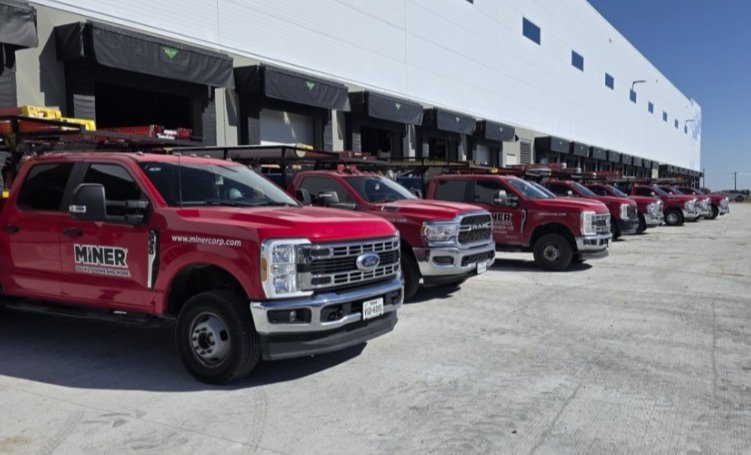
MINER runs a self-perform service network with nationwide coverage. That means MINER loading dock technicians, not subcontractors, handle the bulk of service work at every location. As a result, training and work quality remain consistent regardless of the region a site is in. Similarly, the accountability structure does not change from one location to the next.
SafeCHECK® safety assessments and site surveys from MINER serve as the data foundation for multi-site programs. Each piece of loading dock and door equipment gets logged by condition, age, warranty status, and performance. That data flows into a dashboard that leaders can access on desktop and mobile. The digital dashboard also stores year-over-year data so trends are visible over time.
From that baseline, MINER’s SafeACT Proactive Maintenance Plans set the recurring service schedule for each location. SafeACT uses condition data to focus attention where it is needed most. In addition, all SafeACT work comes with a one-year warranty on parts and labor. Moreover, having one partner handle scheduling, service, and reporting means less time spent on vendor coordination and more time focused on operations.
For companies managing distribution networks, retail chains, or manufacturing campuses at national scale, one accountable partner for industrial door maintenance is a real operational advantage. Connect with our team today to schedule a consultation.