Loading docks are among the most cited areas during OSHA warehouse inspections. The reasons come up again and again: equipment in poor condition, bypassed sensors, and records that do not hold up. For facility managers, the gap between what they think they know about their equipment and what is actually true can be costly. Digital loading dock safety inspections are closing that gap.
Why Traditional Inspection Methods Fall Short
Paper records and informal walkthroughs have a core problem. They capture what a technician noticed on a given day. That record is hard to search, hard to share, and easy to lose. When an OSHA inspector asks for records on a specific asset, a folder of handwritten forms is not a strong answer. When a safety manager wants to compare equipment condition across sites, paper offers no fast way to do it.

The other problem is that informal methods miss what they are not looking for. A general walkthrough may catch an obvious issue. However, it may miss a vehicle restraint that does not engage fully, or a dock seal that has lost compression in one corner.
Structured digital checks use a set list that covers every part of every asset. Because each item is actively reviewed and logged, the process catches problems that informal checks miss. By contrast, informal checks rely on what happens to stand out on a given day.
What a Digital Loading Dock Safety Inspection Covers
A complete digital loading dock safety inspection does more than note visible damage. It checks the condition and performance of every part in the dock area. A thorough program typically covers these items:
- Dock levelers: hold position under load, lip function, and retraction
- Vehicle restraints: engagement reliability, indicator light function, and release mechanism
- Dock doors: track alignment, panel condition, seal integrity, auto-reverse function, and closing speed
- Dock seals and shelters: compression against trailer, tears, gaps, and weatherstrip condition
- Bumpers: structural condition, attachment security, and surface wear
- Dock plates and boards: load capacity visibility, structural integrity, and secure placement
- Safety sensors and warning lights: function, bypass status, and indicator accuracy
- Guardrails and edge protection: condition, anchor integrity, and fall protection compliance
Each item gets a rating and poor-condition items get flagged for repair with a clear priority level. That output gives facility managers real data instead of a general sense that things look okay. In short, it turns a vague status check into a clear action plan.
How Digital Data Supports OSHA Compliance
OSHA does not have a single dock standard. Instead, it applies a set of general industry rules covering walking surfaces, forklift traffic, material handling, and fall protection. What ties those rules together is the expectation that employers find hazards, log them, and fix them.
A digital program supports each of those steps. When every asset gets logged with its condition, age, and performance data, the record is clear and easy to search. Then, when a repair item gets addressed, that action gets recorded too. If an inspector asks how a facility found and fixed a hazard, the answer is now easily accessible in the system. Moreover, that data does not disappear when a technician changes or a paper form gets lost; therefore, digital records hold up better in a compliance review than informal ones do.
For multi-site operators, the value is even greater. OSHA's National Emphasis Program on Warehousing and Distribution Center Operations covers equipment condition as a core focus and applies nationwide. A facility with consistent, documented records across all its locations is in a much stronger position. Still, many facilities do not have that structure in place.
In addition, without a documented baseline, it is hard to show progress between inspections. Ultimately, the facilities best prepared for an OSHA inspection are those that treat documentation as an ongoing practice, not a pre-inspection rush.
How SafeCHECK® Supports Loading Dock Safety Programs
MINER built SafeCHECK® Safety Assessments to address the documentation gap that facility managers face. SafeCHECK® brings MINER safety experts and technicians on-site to survey every piece of dock and door equipment. The SafeCHECK® mobile app guides the survey. It uses a color-coded rating system and a five-star scale to grade each asset by condition.
Results flow into a dashboard that leaders can access on desktop and mobile. The dashboard digitally documents equipment condition across all facilities at once. Data builds over time, so trends are easy to spot and service records are clear. It also helps monitor warranties.
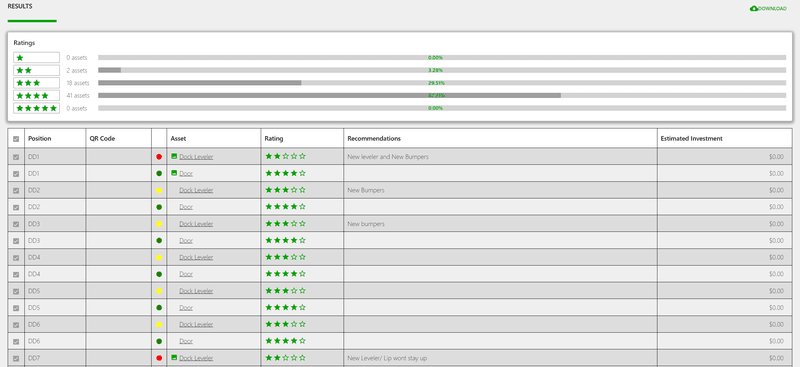
As a result, facility managers have actual data rather than a general impression of how their equipment is running. Similarly, the year-over-year view helps teams plan capital spending based on real wear patterns, not guesswork. Furthermore, for facilities preparing for a regulatory review, a recent SafeCHECK® assessment provides a clear foundation for documentation.
If your facility is running without a structured loading dock safety program and proactive maintenance schedule, reach out to us for answers.