Commercial doors and dock equipment face year-round environmental stress that accelerates wear and unexpected failures. Understanding seasonal risks helps you schedule maintenance at the right time, reduce repair costs, and keep your facility operating safely and efficiently.
Energy cost data underscores why seasonal weather deserves attention across every distribution and warehouse operation. E Source reports that lighting and space heating represent roughly 76% of total energy use in nonrefrigerated warehouses, making them key opportunities for reducing facility energy costs. Structured seasonal maintenance protects both mechanical performance and the utility bills that follow every open dock door.
What Seasonal Weather Impacts Commercial Doors and Dock Equipment?
Seasonal weather stresses commercial doors and dock equipment year-round. Winter cold stiffens hydraulic systems and damages seals, while summer heat and seasonal moisture accelerate wear and expose hidden mechanical weaknesses. Small problems that go unnoticed between seasons often develop into costly breakdowns, unplanned downtime, and reduced energy efficiency, making regular inspections essential for reliable day-to-day operation.
Winter Cold Effects on Commercial Doors and Dock Systems

Winter cold creates the most mechanical stress on commercial doors, dock seals, and hydraulic assemblies throughout the year. Steel contracts in cold temperatures, which places extra load on springs, tracks, and hinges during opening cycles. Hydraulic fluid inside dock levelers thickens below freezing, slowing lip movement and stressing the pump during cycling.
It’s worth noting that torsion springs on overhead doors become more brittle and are more likely to snap under tension. Weather seals harden, crack, and lose the compression needed to block wind, snow, and debris from entering.
Watch for these specific cold-weather damage indicators during winter inspection rounds at your facility:
- Broken or elongated torsion springs on sectional and rolling steel doors
- Cracked or torn weather seals along dock and door perimeters
- Slow hydraulic dock leveler operation during cold morning shifts
- Ice buildup in door tracks, rollers, and dock leveler pits
Common winter failure patterns appear across nearly every industrial facility exposed to freezing temperatures. Winter preparation should always include winter lubrication with cold-rated grease to ensure springs, hinges, and bearings keep moving through freezing temperatures.
Summer Heat and Humidity Impact on Loading Docks
Summer heat drives thermal expansion of metal components across commercial doors, dock levelers, and door hardware inside industrial buildings. Direct sunlight elevates surface temperatures on steel doors well above ambient, causing lock jams and track binding. Ultraviolet radiation and heat break down rubber bumpers, weather seals, and pit gaskets much faster than average.
Just as importantly, humidity accelerates corrosion on hinges, pivot points, and hydraulic fittings across every dock leveler assembly. High summer humidity causes door materials to swell, warp, and absorb moisture across warehouses. Meanwhile, condensation inside cold storage docks produces year-round moisture challenges that reach peak intensity in humid climates.
Storm season brings sudden pressure changes, wind loads, and water infiltration that stress door tracks and dock seals. High winds also place uneven loads on overhead door tracks and hardware. Summer ozone accelerates wear on rubber weather seals, bumpers, and hydraulic fittings. Check out these summer readiness safety tips.
Spring and Fall Transitions Put Added Stress on Commercial Doors
Spring and fall bring the widest daily temperature swings across the operating year for commercial doors and dock equipment. Overnight lows can drop 30 to 40 degrees below afternoon highs during transition seasons in many regions. Repeated thermal cycling stresses seals, springs, and hinges more than steady seasonal temperatures alone.
Additionally, seasonal Heating, Ventilation, and Air Conditioning (HVAC) transitions increase the temperature differential across dock openings each year. Preventive service before winter or summer peak conditions catches most transition-season failures before they cause downtime.
Transition seasons offer the best window for scheduled preventive maintenance across commercial doors and dock systems. Don’t wait for downtime to disrupt your operations; use shoulder-season inspection intervals that catch issues early.
Weather-Driven Energy Loss at the Loading Dock
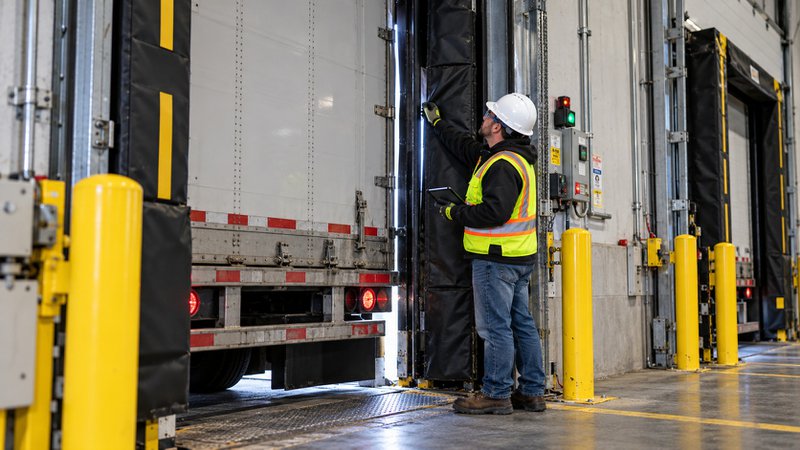
Every open commercial door and every gap in a dock seal produces measurable heat transfer between spaces. Air infiltration through dock openings drives HVAC systems to work harder across every heating and cooling cycle. Weather-driven energy loss accounts for a significant portion of warehouse utility bills across nearly every climate region.
In fact, worn or missing dock seals create air gaps around trailer perimeters that let conditioned air escape rapidly. Insulated overhead doors combined with tight seals reduce infiltration and stabilize interior temperatures across every operating shift. High-speed doors also cut cycle time and limit the duration of open exposure during trailer changes.
Thermal imaging reveals dock and door gaps that visual inspection often misses across large facilities. Learn how we approach energy loss through our energy savings resources for facility-level improvements.
Seasonal Maintenance Practices for Commercial Doors
Structured seasonal maintenance protects commercial doors, dock equipment, and connected safety systems across every operating cycle. Preventive service before each seasonal transition catches most weather-driven damage before it causes downtime. Documentation of every seasonal visit produces the data required for capital planning and warranty support.
Cycle count records help time seasonal service to actual use rather than calendar dates alone. Manufacturer specifications for seals, springs, and hydraulic fluids often include seasonal temperature bands for reliable operation.
Our proactive maintenance services document seasonal cadences used across multi-site industrial operations. Preventive discipline turns weather from an unpredictable threat into a scheduled and budgeted category of work.
No matter the season, MINER delivers comprehensive solutions that keep your facility running smoothly year-round. Contact us today to discuss your facility needs.