Equipment failures on loading docks and industrial doors interrupt production, delay shipments, and increase repair spending across warehouse operations. Downtime costs have risen across the industrial sector over the past several years, according to multiple published surveys. McKinsey reports that outages and shutdowns typically consume between one-third and one-half of total maintenance budgets and can reduce annual production volume by 5-10%. Structured facility maintenance practices reduce the frequency of emergency repairs, extend asset lifespan, and stabilize operating budgets across facilities.
What Are the Best Facility Maintenance Practices to Prevent Failures?
Five practices form the foundation of proactive equipment care: scheduled inspections, condition tracking, operator training, planned part replacement, and expert service coverage. Applied together, these methods identify component wear during early stages rather than after full mechanical failure occurs. Each practice targets a different failure pathway across the equipment lifecycle inside industrial and warehouse facilities.
1. Schedule Regular Facility Maintenance Inspections on Every Asset
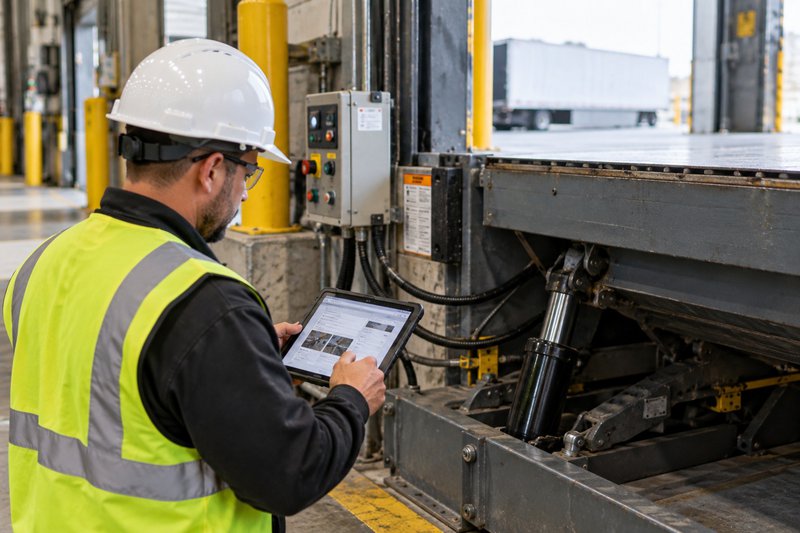
Regular inspections identify component wear on loading docks, industrial doors, and warehouse systems before that wear reaches mechanical failure. Trained technicians examine springs, tracks, cables, hydraulic seals, and door alignment during each scheduled visit to a facility. Documentation from each inspection produces a record of asset condition used for budgeting and replacement planning.
Inspection routines target the components with the highest failure rates under continuous daily use inside warehouses. Focus inspection scope on the following high-wear areas during every scheduled maintenance visit throughout the year:
- Dock levelers, lip extensions, and hydraulic systems that support daily trailer loading operations
- Overhead door panels, tracks, cables, springs, rollers, and safety sensors near active traffic zones
- Trailer restraints, dock bumpers, seals, shelters, and lighting that protect workers and shipments
- Fire doors, smoke curtains, and high-speed doors requiring documented annual compliance checks
On top of that, structured inspection cadences produce documentation used during audits by safety regulators, insurance carriers, or internal review teams. Documented records also support incident investigations by showing the equipment condition history leading up to any event. Typical dock and door inspection frequency runs twice per year, with fire-rated equipment inspected annually per code.
2. Track Equipment Condition With Documented Data
Documented condition data supports maintenance decisions for aging warehouse and dock equipment inside any facility maintenance program. Records of every service ticket, part replacement, and inspection finding produce a full history for each asset. Failure patterns become visible after six to twelve months of accurate maintenance records for individual equipment units.
At the same time, condition data separates assets nearing end-of-life from assets requiring only routine adjustment or lubrication service. Meanwhile, tracked failure trends give budget planners the data required for capital replacement requests each fiscal year. Reactive repairs typically cost two to three times more than the same work performed during scheduled maintenance windows.
Useful data points include cycle counts on dock doors, hydraulic pressure readings on levelers, and motor draw on high-speed doors. Additionally, logs should record every safety incident tied to specific equipment for root-cause investigation across the operation. Motor current variation of more than 10 percent from baseline often indicates bearing wear, alignment issues, or electrical faults.
Digital tracking tools give managers access to full asset histories during budget reviews and vendor conversations. Data collection over multiple years reveals seasonal wear patterns that adjust the timing of preventive interventions.
3. Train Staff to Support Your Facility Maintenance Strategy
Operators, forklift drivers, and site supervisors should observe equipment behavior across every shift before scheduled technicians arrive on site. Training staff to recognize early warning signs extends observation coverage across your facility maintenance strategy every operating hour. Trained staff report unusual noises, sluggish door movement, and visual damage during the shift when those symptoms first appear.
Structured training also reduces misuse of dock equipment, which industry data links to a large share of premature component failures. Operators familiar with the mechanical function of a dock leveler apply loads within its rated capacity during daily use.
Clear reporting channels move concerning observations to maintenance leadership within minutes of the initial observation. In addition, refresher sessions align newer staff with veteran team members on safety protocols and inspection procedures. Cross-training across shifts maintains reporting continuity during vacation coverage and seasonal peak periods each year.
According to Oxmaint's 2025 industry report, roughly 80 percent of production stoppages still trace directly back to equipment failure. Awareness training on high-cycle components like dock seals, bumpers, and door bottom astragals shortens detection time for early damage. Review MINER's safety and uptime guidance for foundational staff education material.
4. Replace Wear Parts Before They Fail
Wear parts drive the operational lifespan of every dock leveler, overhead door, and material handling asset in service. Bearings, springs, rollers, cables, hydraulic seals, and weather seals follow measurable life cycles under normal daily operating conditions. Scheduled replacement of these components costs a fraction of the labor and parts required after full mechanical failure.
However, many facilities operate components until visible failure, which increases labor cost, downtime hours, and safety exposure. Planned replacement based on component life curves converts your facility maintenance budget from unpredictable to a scheduled line item. Component life data comes from manufacturer specifications, cycle counters, and historical service records collected on site.
Cold storage, food processing, and 24/7 distribution operations produce faster wear rates than lightly used commercial buildings. Meanwhile, weather exposure, chemical presence, and cycle counts shift replacement intervals in measurable directions across different regions.
On-site inventory of common replacement parts reduces response time when a proactive change becomes necessary during operations. In addition, dock bumpers, weather seals, and torsion springs represent the most frequently replaced items across most warehouse operations. Standard high-cycle bumpers compress permanently after repeated impact, losing shock absorption after roughly 25 to 30 percent thickness loss.
5. Partner With Facility Maintenance Experts for Proactive Service
Facility maintenance operations often combine internal discipline with external expertise from a dedicated national service partner. Specialists bring calibrated tools, brand-neutral equipment knowledge, and Occupational Safety and Health Administration (OSHA) aligned procedures to each site visit. Proactive service programs produce predictable pricing, scheduled visits, and priority response during emergency events.

Also, a service partner documents every visit and tracks equipment history across your sites during each service call. Multi-site operators receive one accountable point of contact across every location covered under the service agreement.
Evaluation criteria for service partners include coverage across every major brand rather than a single manufacturer's product line. Additionally, review emergency response times, technician certifications, and parts inventory depth before signing any long-term service contract.
Scheduled proactive visits pair with annual site assessments that document safety conditions and equipment performance across the facility is the best practice.
Strengthen Your Facility Maintenance Program Today With MINER
Preventing unexpected equipment failures depends on documented routines, condition tracking, trained staff, planned part replacement, and expert service coverage. A structured facility maintenance program can produce measurable reductions in downtime hours, repair spending, and safety incidents across warehouse sites. Each practice supports the others by producing the data, awareness, and scheduled work required for reliable operations.
Contact us to schedule a consultation to better understand your maintenance service needs.