Loading dock equipment carries heavy daily mechanical stress inside any warehouse or distribution facility. You face a repair-or-replace decision every time a component fails. Small choices each year add up to significant differences in downtime, safety, and capital spending.
Industry lifespan and cost data give you a framework for repeatable decisions across assets. According to Pentalift, dock levelers have a life expectancy of approximately 10 to 25 years, depending on operating conditions and frequency of use. Better outcomes follow when you weigh age, cost, safety, and downtime together, not separately.
When Should You Repair or Replace Your Dock Equipment?
Repair the asset when damage stays minor, structural integrity holds, and repair cost remains reasonable. Replace it when age exceeds service life, safety concerns emerge, or repair cost approaches replacement price.
Assess the Age and Condition of Your Dock Equipment
Age drives most repair-or-replace decisions across dock equipment inside industrial and warehouse facilities. Each dock leveler type carries a different expected service life based on design and load. Mechanical levelers reach five to seven years, while hydraulic and air units run ten years-plus.
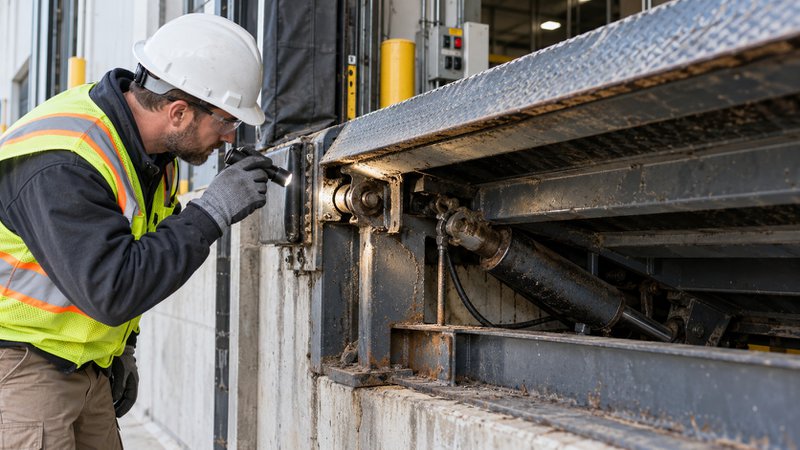
Remaining life shows through visible condition, cycle counts, and inspection findings from service visits. Focus your condition assessment on these specific areas during any repair-or-replace evaluation cycle:
- Frame and deck rust, cracking, or weld failure at lift points
- Hydraulic leaks, pressure loss, and pump cycling during operation
- Spring fatigue, cable wear, roller degradation, and hinge play
- Control panel function, sensor operation, and safety interlock integrity
Hidden structural issues often emerge once technicians pull covers, inspect the pit, and cycle motion. Consider dock leveler repair services for structural evaluation before major repair spending. Installation date compared against manufacturer service life gives a clear age signal on any asset. Combine that age data with your recent repair history to see whether small issues have started stacking. Repair frequency in the last twelve months tells you more than a single incident report.
Compare Repair Costs Against Replacement Value
Cost comparison gives the clearest financial signal on repair-or-replace decisions for dock equipment. Repair cost as a percentage of replacement value guides most facility decisions. According to Door Systems, reconsider repair once repair cost exceeds 25 percent of replacement. Age of the equipment also weighs against that percentage when you make your final call.
Total repair spend across the past twelve months on the same asset also matters. Small repairs can quickly add up to a number approaching the cost of full replacement. Newer replacement units also carry warranty coverage, energy gains, and updated safety features.
Hidden costs surface when the calculation includes parts availability, downtime hours, and operator training. Ensure your service partner produces itemized quotes that let you compare each option against actual conditions. Also consider whether the recommended equipment is the best fit for your facility’s operational requirements. Working with a provider that can evaluate multiple equipment options ensures recommendations are based on application needs, performance goals, and long-term value.
Watch for Safety Signals That Require Dock Equipment Replacement
Safety issues on aging dock equipment override cost calculations inside any responsible facility. Structural corrosion, weld cracks, or frame deformation on a dock leveler creates fall-through risk. Missing safety interlocks on doors and levelers expose your workers to preventable injury during operation.
Any of your equipment that fails current safety codes deserves replacement even when mechanical function works. Newer safety standards on restraints and interlocks apply during any facility retrofit. Insurance carriers also increasingly require compliance with current safety standards as a coverage condition.
Safety-driven replacement needs surface earliest when technicians follow documented inspections at manufacturer intervals. Document every safety concern with photos, measurements, and timestamps for your future audit conversations. The same records also justify the capital request when leadership asks why replacement cannot wait. Learn more about building a culture of safety, beyond checkboxes.
Make Data-Driven Decisions to Minimize Downtime and Operational Disruption
The true cost of a dock equipment decision goes beyond the repair invoice. Downtime, emergency service costs, delayed shipments, and operational disruption can quickly outweigh the upfront savings of another repair. At the same time, maintenance records, repair frequency, inspection findings, and asset age provide the data needed to identify equipment approaching end-of-life before failures occur.
By combining operational data with lifecycle, safety, and cost considerations, facility leaders can make more confident repair-or-replace decisions that reduce unplanned downtime, improve budgeting accuracy, and support long-term reliability. Learn more about our proactive maintenance safety and service programs to support smarter asset management.
Make Smarter Dock Equipment Decisions With MINER
There’s no one-size-fits-all answer to repairing or replacing dock equipment. The best decision balances equipment age, repair costs, safety risks, expected lifespan, maintenance history, and the operational impact of downtime. Together, these factors create a framework for maximizing uptime while optimizing maintenance and capital investments.
Not sure if you need to repair or replace? Contact MINER to take the guesswork out.