Warehouse throughput measures how many goods your operation moves through receiving, storage, picking, and shipping. Material handling drives most of that number through daily movement of every pallet, case, and unit. Small inefficiencies in travel time, equipment use, and storage compound into significant lost capacity over months.
Industry data shows throughput responds to focused material flow improvements across distribution operations of any size. According to ISM Logistics, warehouses have cut picking time 20 to 30 percent through better layout design. You improve warehouse throughput by optimizing material handling across five (5) key areas: layout, equipment, maintenance, training, and technology. Each lever addresses a specific bottleneck documented across industry studies and operational assessments. Layered changes produce measurable gains in units-per-hour, order accuracy, and cost-per-order at any facility.

1. Optimize Warehouse Layout for Efficient Material Handling
Warehouse layout drives the distance every material handling task must cover across pallets, cases, and picks. Fast-moving stock near packing cuts travel time on your highest-volume orders each shift. Layout choices also determine whether forklifts, walkies, and pickers share aisles or move on separate paths.
Layout audits reveal travel waste inside operations that grew organically over multiple years. Focus your improvement work on these specific layout areas during any material handling redesign project:
- Slotting fast-moving Stock Keeping Units (SKUs) near shipping lanes and packing stations
- Dedicated forklift and pedestrian lanes with painted markings and physical barriers
- Cross-docking zones sized for daily inbound and outbound trailer patterns
- Bulk storage kept separate from pick zones and replenishment paths
When receiving and shipping doors sit near their staging areas, cross-facility travel drops each shift. Test small pilot zones for slotting and lane changes before a full redesign. Before-and-after data on picking time confirms whether the changes produced the expected operational gains. Consider partnering with facility experts to ensure your loading dock system supports your layout goals. From ground-up developments to tenant improvements or extensive remodels, MINER’s construction services team can handle all of them.
2. Right-Size Equipment for Your Throughput Goals
Equipment selection sets the throughput ceiling inside every material handling operation across warehouses and distribution centers. Undersized forklifts and walkies force operators into double-handling, split loads, and reduced pick paths daily. Oversized equipment also wastes capital and creates safety risk inside aisles built for smaller vehicles.
Dock levelers, doors, and trailer restraints also affect the trailer-to-floor transfer rate during unloading. High-speed doors cut cycle time and reduce climate loss versus sectional doors during trailer changes.
Vertical reciprocating conveyors and mezzanines expand storage capacity without changing your building footprint. Right-sized racking with correct beam heights also lets pallets move without extra fork adjustments. Powered pallet jacks matched to aisle width and rack height also cut pick-cycle time across shifts.
Equipment selection benefits from operational data on unit throughput, cycle time, and travel patterns. Review our warehouse facility management services for equipment specification support across every multi-site operation. Right-sizing decisions made against real data outperform choices based on manufacturer catalog assumptions alone.
3. Maintain Material Handling Equipment to Prevent Downtime
Unplanned downtime cuts throughput more sharply than almost any other operational failure inside material handling operations. Every forklift out of service, dock leveler stuck, or door jammed removes measurable daily capacity. Scheduled preventive maintenance keeps that capacity available across shifts, seasons, and peak sales periods.
Documented maintenance history helps you predict which assets need capital replacement across future budget cycles. Trending failure modes across similar assets also guides better purchasing during equipment refresh windows. Cycle-count triggers rather than calendar dates match maintenance intervals to actual usage on assets.
Preventive service also costs a fraction of emergency repair across a full asset lifecycle. Proactive maintenance also produces the inspection records required for warranty, insurance, and regulatory audits.
4. Train Operators and Track Throughput Metrics
Operator skill drives daily throughput more than almost any other single factor inside material handling operations. Trained forklift and pallet jack operators move loads faster, damage fewer products, and cause fewer incidents. Formal certification programs also protect you during Occupational Safety and Health Administration (OSHA) audits.
Cross-trained operators reduce bottlenecks when specific stations lose workers to vacation, illness, or turnover. Metrics from operator performance data identify training needs, coaching opportunities, and layout issues affecting productivity. Time-per-pick and units-per-hour comparisons across shifts also reveal opportunities that casual observation misses.
Throughput dashboards give supervisors and managers a shared view of daily performance against target rates. Exception reports also highlight mis-scans, idle equipment, and queue buildup for prompt action across the floor. Consider linking training records, incident reports, and throughput data into a single dashboard per operator.
Consider operator training programs and safety audit programs to mitigate risk and protect your employees.
5. Integrate Technology Into Material Handling Workflows
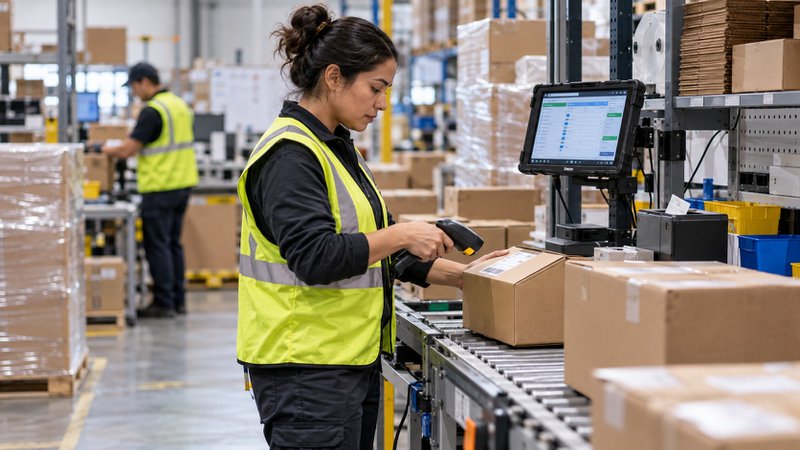
Technology integration multiplies the impact of every other material handling improvement across your warehouse operation. Warehouse Management System (WMS) platforms coordinate tasks across receiving, storage, picking, and shipping in real time. Barcode and Radio Frequency Identification (RFID) scanning cut errors that would otherwise force rework across shifts.
Pick-to-light and voice-picking systems also reduce errors while lifting units-per-hour on high-volume pick lines. Automated conveyors, sortation, and Automated Storage and Retrieval Systems (AS/RS) also absorb repetitive tasks on the floor.
Real-time visibility of orders, inventory, and equipment status also drives faster decisions among supervisors and staff. Integration between the WMS and dock scheduling systems cuts trailer wait times and yard congestion.
Thermal imaging, cycle counters, and equipment sensors also add condition data that improves preventive maintenance scheduling. Integrated systems turn scattered data into a coordinated operating picture that supports daily decisions.
Improve Your Material Handling Program With MINER
Warehouse throughput responds to changes across layout, equipment, maintenance, training, and technology within every material handling operation. Each lever addresses a specific bottleneck that would otherwise cap your daily units-per-hour and order accuracy. Layered changes produce measurable gains in capacity, cost per order, and customer service metrics.
Contact us today to discuss your material handling needs.