A dock leveler operates as one of the most mechanically stressed assets inside any warehouse or distribution facility. Loaded forklifts, arriving trailers, changing weather, and heavy daily cycle counts all attack the leveler simultaneously. Damage rarely comes from a single event and instead develops through hundreds of small impacts over months.
Understanding those damage sources lets you design targeted prevention around the actual failure pathways. Documented root causes give operators, supervisors, and technicians a shared framework for daily inspections and repair scheduling.
The Four Main Causes of Dock Leveler Damage
The main causes of dock leveler damage include forklift impact, trailer separation, environmental corrosion, and deferred maintenance across daily operations. Each cause produces a specific wear pattern documented across manufacturer bulletins and Occupational Safety and Health Administration (OSHA) guidance. Prevention starts with matching the right corrective action to the observed damage pathway on each individual leveler.
1. Forklift Impact and Daily Traffic on the Dock Leveler
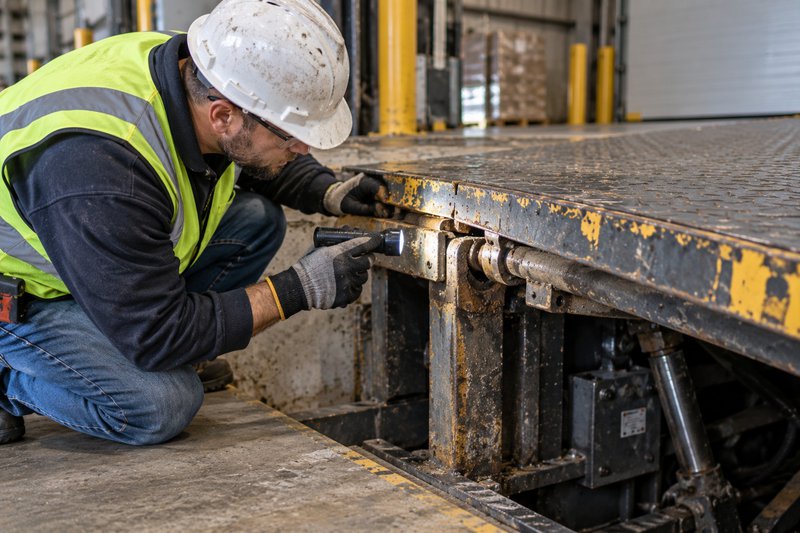
Loaded forklifts crossing a dock leveler produce the single largest source of daily mechanical stress on the assembly. According to Safety+Health Magazine, dock levelers are typically crossed more than 100 times each working day inside busy facilities. Repeated impact loads deform the lip, wear the hinge points, and fatigue the springs over time.
Also, forklifts rarely cross the leveler at uniform speeds, which creates uneven stress on the deck and rear hinge. Corner strikes from forks and loads damage the leveler edges, side gaskets, and control panels near the pit.
Common forklift-related damage modes appear across nearly every high-volume warehouse operation using powered industrial trucks. Watch for these specific damage indicators during daily inspection rounds at your facility:
- Bent or cracked lip edges caused by forklift wheel impact during trailer crossings
- Deck deformation and paint wear along common forklift travel paths across the leveler
- Damaged side gaskets, weather seals, and pit trim from repeated corner strikes
- Loose or missing fasteners on the rear hinge assembly due to vibration and stress cycles
Driver training plays a key role in reducing impact severity by encouraging slower crossing speeds and proper load positioning during trailer entry. Fleet telematics data can further support prevention efforts by identifying operators whose crossing patterns generate the highest impact loads on dock levelers. Following any high-impact event, consider a structural assessment through dock leveler repair services.
2. Trailer Separation and Impact From Truck Movement
Trailer movement during loading and unloading generates sudden shock loads on the dock leveler and surrounding structure. Trailers creep away from the dock, land hard during coupling, or leave prematurely before workers exit the interior. Each event produces impact damage to the leveler lip, hinge assembly, and pit walls at high velocity.
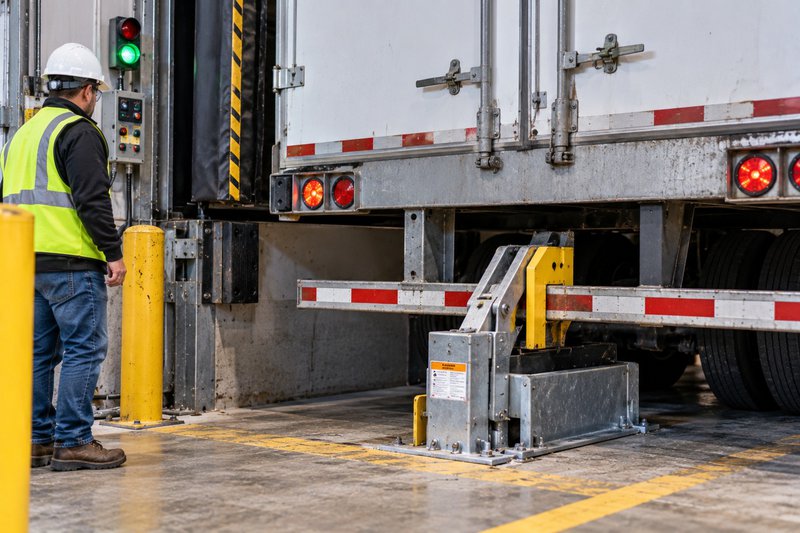
In fact, early trailer departure ranks among the highest-severity events at any loading dock area. Trailer restraints and communication lights address this failure mode through mechanical locking and visual signaling to drivers. Meanwhile, poor trailer parking angles produce lateral stress on the lip and side plates during forklift crossings.
Landing gear failure adds another category of impact damage during trailer loading and unloading operations. Additionally, trailers with damaged suspensions or air systems shift vertically during loading, hammering the leveler with each cycle. Wheel chocks and glad-hand locks help reduce trailer movement risk during loading, but they should be used as supplemental controls alongside a properly engaged vehicle restraint.
3. Weather, Corrosion, and Environmental Wear on Dock Leveler Systems
Environmental exposure attacks a dock leveler from multiple angles across every operating season inside industrial facilities. Rain, snow, road salt, humidity, and temperature swings all contribute to corrosion of the deck, hinges, and hydraulic components. Cold storage docks add extreme temperature differentials that stress seals, gaskets, and hydraulic fluid viscosity.
Additionally, corrosion often begins in the pit where water pools after cleaning or precipitation events. Rust reduces the load capacity of structural welds and shortens the operating life of the entire assembly.
Chemical exposure inside food processing, pharmaceutical, and manufacturing facilities also accelerates degradation of metal and rubber components. Additionally, wash-down procedures increase corrosion risk when water reaches hydraulic seals and electrical components in the pit. Regular pit drainage inspection prevents most corrosion damage before it reaches critical structural components.
4. Deferred Maintenance and Skipped Inspections
Skipped inspections and delayed repairs allow small issues to progress into full mechanical failure of the dock leveler. Missing lubrication schedules wear bushings, pins, and rollers at a much faster rate than manufacturer specifications allow. Deferred hydraulic service leads to seal failure, fluid contamination, and eventual pump replacement at high cost.
Meanwhile, small cracks in welds and structural members grow under repeated cycling once left unaddressed for months. Damaged bumpers transmit trailer impact directly into the leveler face and pit walls instead of absorbing it. Missing or torn weather seals let debris, water, and pests into the pit where corrosion accelerates rapidly.
Cost data shows reactive repairs typically run two to three times higher than the same work performed on schedule. Additionally, emergency service calls carry premium labor rates and often require overnight parts shipping for critical components.
Documented inspection records help identify the check points producing the highest defect discovery rates across your operation. Review our safety and uptime guidance for insight into inspection intervals that catch damage early. Version-controlled inspection logs also support insurance and warranty claims during any dispute over equipment condition.
How to Prevent Damage With Structured Care
Prevention comes down to structured care that reduces emergency repairs, extends asset life, and prevents the highest-severity damage events. Each major task area ties directly to a targeted intervention:
- Operator training – slower crossing speeds, proper loading positioning, and reduced impact damage
- Trailer restraints – prevent early-departure incidents that cause severe leveler failures
- Environmental controls – pit drainage, weather seals, paint cycles, cold-storage insulation, and specialized hydraulic fluids
- Scheduled maintenance – routine service that lowers emergency repair frequency and supports capital planning
- Rapid damage response – stopping small issues before they escalate into structural or safety risks
- Proactive inspections – intervals matched to cycle counts and manufacturer specifications
- Documented maintenance history – informs end-of-life planning and long-term budgeting
MINER’s operational excellence programs help facilities of all sizes build consistent prevention routines that reduce downtime, lower total repair costs, and cut recordable incidents.
Schedule a consultation with our facility experts today!